Comparison 2026
Retrofitting a control panel: PCU and other systems compared.
Which system suits your onboard network?
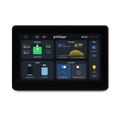
Retrofitting a control panel or onboard display usually means choosing between four system types: a pure battery monitor, a modular display system with add-on modules, a wireless retrofit system with a central unit and wireless modules, or a control panel from a device manufacturer. The philippi PCU combines display and control in one touch display: CI, CAN and LIN bus, four tank and two temperature inputs are built in. You only add the PSU for lights and loads.

CI, CAN, LIN built into the display, no add-on module.
4 tanks, 2 temperatures measured directly at the display.
Offline no app, no subscription, no internet.
Advice: +49 7146 8744-0, directly from Remseck.
The key points in one minute
- Everything in the display: CI, CAN and LIN bus, up to four tank senders and two temperature sensors connect directly to the display. No tank module, no wireless modules, no separate control unit.
- Cable instead of wireless: readings and switching commands run over wires and bus, not over radio. Why we do it this way.
- Monitor and operate: see battery, tanks and energy flow; operate heater, fridge and air conditioning via CI and CAN bus.
- PSU only for switching: you switch and dim lights and 12 V or 24 V loads with the PSU Switching Unit; every output is electronically protected.
- Offline: own software, runs without internet, without an app and without a subscription.
- Works across brands: Truma, Dometic, Votronic, SuperB, SuperSense and BullTron; Victron inverter/chargers and solar chargers via the Smart Interface SMI.
How an onboard network with a control panel is set up
In a motorhome, two parts usually work together: the power unit or distributor, where leisure battery, starter battery, shore power, charger and fuses come together, and the control panel on the wall, which switches main switch, lights and pump and shows voltage and tank levels. Both are usually connected by a manufacturer-specific data cable. In addition, heater, fridge, air conditioning, solar charger and battery computer often come with their own control unit. On boats, in expedition vehicles and in self-builds there is often no power unit; switch panel and fuse distributor take over its job.
Replace, add or rebuild?
- The panel is faulty: usually only a replacement panel from the maker of your power unit fits, because both talk over their own data cable. The rating plate on the power unit helps when ordering.
- The panel does too little: you do not need to replace it. The PCU adds to it: it reads battery, tanks and temperatures itself and operates bus devices. The old panel and the device control units can stay.
- Self-build, boat or expedition vehicle: plan display and power distribution together. The PCU shows and operates, the PSU replaces relays, fuses and switches with eight electronically protected outputs.
Monitoring: PCU, battery monitor and modular display system
| Feature | philippi PCU | Pure battery monitor | Modular display system |
|---|---|---|---|
| Battery | with shunt; BullTron via P-BUS without shunt | with shunt | with shunt module |
| Tanks | up to 4, directly at the display | usually not | via tank module |
| Temperature | 2 sensors directly at the display | usually battery only | via module |
| Operate heater, fridge, air conditioning | via CI and CAN bus | no | usually not |
| Switch lights and loads | with PSU: 8 outputs, dimmable, each output protected | no | usually via a separate switching system |
Control: PCU, wireless retrofit system and manufacturer control panel
| Feature | philippi PCU | Wireless retrofit system | Control panel from a device manufacturer |
|---|---|---|---|
| Set-up | one display, interfaces built in | central unit plus one wireless module per function | panel for one manufacturer's devices |
| Connection | cable and bus (CI, CAN, LIN) | radio between central unit and modules | usually cable |
| Tanks and battery | tanks directly at the display, battery with shunt | a separate module per function | often only with further components |
| Devices from other brands | Truma, Dometic, Votronic, SuperB, BullTron; Victron via SMI | via matching modules | usually limited |
| Lights | with PSU, every group dimmable | via light modules | usually not |
| Internet and app | not needed, runs offline | usually an app, remote access sometimes via SIM card | depends on the manufacturer |
The tables describe typical system types, not specific products. Individual devices may differ. As of 19 November 2026.
Why we rely on cable instead of wireless
Wireless saves cable runs when retrofitting. For measuring, switching and control in the onboard electrical system we still advise against it. That is why the PCU deliberately sends readings and switching commands over wires and bus:
- Metal shields radio: bodies, lockers and hulls made of aluminium or steel attenuate or block radio signals, leaving a radio shadow behind them. A cable does not have this problem.
- No interference from other networks: at campsites and marinas, many Wi-Fi and Bluetooth devices are transmitting. Radio systems in the same frequency band can interfere with each other. CI, CAN and LIN bus transmit over their own wires.
- No pairing, no batteries: wired sensors are powered through the cable and need no pairing. A wireless module still needs power, so either a battery or a wire after all.
- No over-the-air eavesdropping: readings and switching commands do not travel by radio, so they cannot be intercepted or jammed remotely. The PCU needs neither internet nor an app.
- Made for vehicles: the CAN bus comes from automotive engineering and detects transmission errors itself.
A cable is laid once. After that, nothing needs to be paired, charged or reconnected. The Connect Hub keeps the effort low: all sensors connect at one point, and one cable runs to the display. If you also want to see the values on your phone, add the Smart Interface SMI; it sends them via Wi-Fi to the free philippi app. Measuring and switching still run over cable.
The interfaces in brief
- CI bus: the caravanning industry standard, developed in 2011 under the lead of the CIVD association. Devices from different makers, such as heater and fridge, use it to talk to a central unit.
- CAN bus: robust bus system from vehicle technology, used by many batteries, chargers and newer devices.
- LIN bus: simple bus for individual devices and sensors, for example the SHE 348 shunt.
- Manufacturer-specific interfaces: such as VE.Direct and VE.Can at Victron. The PCU integrates Victron devices via the Smart Interface SMI.
- Simple sensor signals: tank senders with a resistance signal, for example 10 to 180 ohms, and temperature sensors. The PCU measures both directly at the display.
Retrofitting a control panel in four steps
- Take stock: note which devices are installed, such as heater, fridge, air conditioning, charger, solar charger, batteries and tanks, and which interface they use: CI bus, CAN bus, LIN bus or a simple sensor signal. The compatibility list shows what the PCU integrates directly.
- Choose the mounting position: with frame, the PCU needs a cut-out of 140 × 85 mm. Cut-out, mounting depth and first start-up are explained in Installing the PCU.
- Connect sensors and bus: tank senders, temperature sensors and shunt connect directly to the display or tool-free to the Connect Hub, from which one cable runs to the display. Bus devices connect via CI, CAN or LIN bus.
- Set up: on the display you add tanks, batteries and devices: setting up tanks, battery values, controlling devices via CI and CAN bus.
Touch display and push buttons
You operate the PCU on its touch display. If you also want familiar wall push buttons, connect them to the PSU inputs: push buttons, switches and display work together, and the PSU switches even without a display. So lights stay switchable when someone comes on board with wet hands or looks for the switch in the dark.
Checklist before retrofitting
- All devices noted with maker and model: heater, fridge, air conditioning, charger, solar charger, inverter, batteries, tanks.
- Interface known for each device: CI bus, CAN, LIN, manufacturer-specific or just a sensor signal.
- System voltage 12 V or 24 V clarified; the PCU works with both.
- Mounting position chosen where you pass every day; cut-out with frame 140 × 85 mm.
- Decided which wall push buttons should stay; they connect to the PSU.
- Checked in the heater manual whether the original control unit must remain installed.
- Work on 230 V left to a qualified electrician.
Which system type suits you?
- Only the battery in view: a pure battery monitor is enough.
- View battery and tanks, operate nothing: the BTM2 battery-tank monitor, also on the chart plotter via NMEA 2000. The PCU can do this too, without a tank module.
- P-BUS installation on a yacht or expedition vehicle: the PSM3 or the PSL as system monitor.
- Only operate one manufacturer's devices: that manufacturer's control panel.
- No way to lay cables: a wireless retrofit system. Keep in mind the limits of radio in vehicles.
- Battery, tanks, devices and lights on one display, across brands and without internet: the philippi PCU, with the PSU for lights and loads.
Which philippi monitor suits you?
The PCU is not philippi's only monitor. If you only want to see values, or already have a P-BUS installation on board, one of these units is often the better choice:
| Monitor | Shows | Switches and controls | Suits you if | Price |
|---|---|---|---|---|
| BTM2 | house battery with shunt, voltage of up to 2 further batteries, up to 4 tanks; 3.5″ touchscreen | relay contact for the FHR 265 main switch as deep-discharge protection | you only want to see battery and tanks, also on the chart plotter via NMEA 2000 | €285 |
| PSM3 | all data from the P-BUS devices: batteries, tanks, temperatures, energy flow; 3.5″ touchscreen | main switches and loads via P-BUS modules | your yacht or expedition vehicle has or will get a P-BUS installation, also with several displays | €369 |
| PSL | like the PSM3, on three freely arranged pages; 5″ touchscreen | main switches; switch and dim loads via the CMR relay module | you have a P-BUS installation with a large display and a Studer or Mastervolt inverter | €479 |
| PSL Plus | like the PSL, plus up to 4 tank senders and 2 temperature sensors directly at the display | like the PSL | you do not want a separate tank interface in the P-BUS system | €499 |
| PCU | battery, up to 4 tanks, 2 temperatures, energy flow; touch display | heater, fridge and air conditioning via CI and CAN bus; lights with the PSU | you want to operate devices from different brands on one display | €479 |
In short: only display, BTM2; P-BUS installation, PSM3 or PSL; operate devices, PCU. Shunt, tank senders and connecting cables are not included in the price; each product page lists what goes with which monitor. Prices incl. VAT, as of 20 November 2026.
Not sure whether your devices fit? Check the compatibility list or send us your device list: ask for advice.
The PCU at a glance
| Component | Purpose | Price |
|---|---|---|
| Control Unit PCU | display with CI, CAN, LIN bus, 4 tank and 2 temperature inputs | €479 |
| Shunt SHE 348 | battery current and state of charge | €119 |
| Connect Hub | all sensors at one point, one cable to the display | €79 |
| PSU Switching Unit | switch, dim and protect lights and loads | €419 |
| Smart Interface SMI | integrate Victron devices | €199 |
More on this: PCU or conventional battery monitor and Retrofitting a tank gauge.
Demo
Try it instead of comparing. The PCU display in your browser.
Tap through overview, battery, tanks, energy flow and loads, just as on the display on board, in an expedition vehicle or in a motorhome.
Expand when you need more. Switch lights, bundle sensors, integrate Victron.
Lights and loads with the PSU.
Dim every light group to the percent, switch each of the eight outputs and protect it electronically.
View the PSU
Victron on the PCU display.
With the Smart Interface SMI you integrate Victron inverter/chargers and solar charge controllers (MPPT). Via Wi-Fi or Ethernet, the data also goes to the free philippi app.
View the Smart Interface
All sensors at one point.
You connect tank sensors, shunts and batteries tool-free to the Connect Hub. Only a single 10 m cable runs to the display.
View the Connect Hub
Products
Everything for your control panel. Order directly.


Frequently asked questions. About the control panel.
What is a control panel for motorhomes, expedition vehicles and boats?
A control panel shows the values of the electrical system in one place: battery state of charge and current, tank levels, temperatures and the energy flow from solar, DC-DC charger and shore power. Depending on the type, it also operates devices such as heater, fridge and air conditioning and switches lights and loads. The philippi PCU does both, with the PSU for lights and loads.
Can I keep my existing control panel?
Yes. The PCU adds to the existing control panel; it does not have to replace it. It reads battery, tanks and temperatures itself and operates bus devices via CI, CAN and LIN bus. Power unit, old panel and the control units of heater or fridge can stay. Whether the heater's original control unit must remain installed is stated in its installation manual.
Do I need add-on modules for the PCU?
Not for tanks, temperature and bus devices: CI, CAN and LIN bus, four tank and two temperature inputs are in the display. Measuring battery current needs a shunt, for example the SHE 348; BullTron Polar batteries report via P-BUS without a shunt. To switch and dim lights and loads, you need the PSU Switching Unit.
What is the CI bus in a motorhome?
The CI bus is the networking standard of the caravanning industry. It was developed in 2011 under the lead of the CIVD association so that devices from different makers, such as heater and fridge, can talk to a central control panel. The PCU has the CI bus built into the display, plus CAN and LIN bus.
PCU or wireless retrofit system: which suits better?
A wireless retrofit system connects a central unit by radio to one module per function, for example for tank, battery or lights. This saves cable runs, but metal in the body, range and other radio networks can disturb the connection, and every module still needs power. For measuring and control in the onboard electrical system we therefore advise against wireless: with the PCU, readings and switching commands run over cable and CI, CAN and LIN bus, and the tank and temperature inputs are in the display. You only add the PSU for lights and loads, and the PCU runs without an app or internet.
Can the PCU show Victron devices?
Yes. Via the Smart Interface SMI you integrate Victron inverter/chargers and solar charge controllers (MPPT) and see and control them on the PCU display. Via Wi-Fi or Ethernet, the data is also sent to the free philippi app.
Which vehicles is the PCU suitable for?
For boats and yachts, expedition and off-road vehicles as well as motorhomes, vans and caravans. The PCU works with 12 V and 24 V systems and all common battery types.
Does the PCU need internet, an app or a subscription?
No. The PCU runs its own software locally on the display, even without mobile reception at sea or off the road. There is no subscription. If you also want to see the data on your phone, connect the PCU via the optional Smart Interface SMI over Wi-Fi or Ethernet to the free philippi app.
Advice
Does the PCU fit your devices? We check it for you.
Send us your device list with heater, fridge, batteries and tanks. We tell you what the PCU integrates directly.