

SHX Shunt Manual: Battery Management and Current Measurement on the P-BUS.
The SHX shunt measures the current and voltage of a battery in the P-BUS system. It works in two operating modes: as the SHX-C battery management shunt, which calculates the state of charge, or as the SHX-L current measuring shunt, which shows the current of a charging source or load on the DC energy page of the system monitor. Here you will find wiring, switching the operating mode, settings and the capacity test.
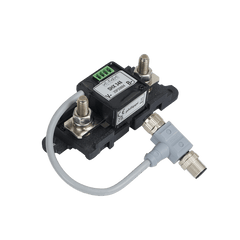
Two operating modes
| Operating mode | Task |
|---|---|
| SHX-C, battery management (as delivered) | records all charge and discharge currents and the voltage, calculates the state of charge after an initial synchronisation and monitors full charge, critical state of charge and deep discharge |
| SHX-L, current measurement | measures the current of an energy source such as an alternator or solar panels, or of a load, and counts the energy yield or consumption |
The connection to the philippi P-BUS is made via an M12 T-connector. The operating mode is switched on the system monitor. Keep the system monitor software up to date.
Intended use and safety
The SHX works only in conjunction with the P-BUS on extra-low DC voltage of 8–32 V. It is designed for use on yachts and in vehicles and may only be operated in enclosed spaces protected from rain, moisture, dust and condensation. Do not install where there is a risk of explosion from gas or dust, and not outdoors.
- No modifications may be made to the unit, otherwise the CE mark becomes void.
- Have the connection carried out only by qualified electricians and disconnect the battery cables first.
- Observe correct polarity.
- The unit is not intended for use by children.
Scope of delivery: SHX shunt, 4-pin pluggable terminal, ASH1 fuse holder with FSS 1 A fuse and user manual. Optional: TEMP-BT temperature sensor.
Warranty: two years from the date of purchase. Material or manufacturing defects are remedied free of charge if the unit is sent to the manufacturer carriage paid, the proof of purchase is enclosed, the unit has been used as intended and no third-party spare parts have been fitted or interventions made. Excluded is damage caused by overvoltage at the inputs or reverse polarity, ingress of liquids or oxidation due to condensation, and lightning strike; consequential costs and natural wear are not covered. philippi accepts no liability for damage resulting from incorrect installation or improper operation.
Wiring
Mount the SHX in a protected, dry place as close as possible to the battery. The shunt sits in the negative path.
- SHX-C mode: the B− side goes alone to the negative pole of the monitored battery bank. All loads, charging sources and starter batteries go to the other side.
- SHX-L mode: the shunt sits in the negative path of the source or load whose current is to be measured, for example the solar system.
| Terminal (4-pin) | Function |
|---|---|
| 1 (+1) | Voltage measurement of the battery and supply of the shunt, fused with the supplied fuse holder (1 A). Required; disconnect only during winter storage so that the capacity is recorded without gaps. |
| 2 (+2) | Either the voltage of a second battery bank (e.g. the starter battery) or the midpoint voltage of a 24 V bank made of two 12 V batteries in series. If it deviates from half the total voltage by more than 2 %, the bank is shown in red: then check the batteries for a shorted cell or unequal state of charge. |
| 3 (T−, T+) | Optional: TEMP-BT temperature sensor, attached to the outside of the battery housing. The temperature is for information only. |
| Shunt LED | Meaning |
|---|---|
| rapid flashing | Firmware update in progress |
| flash every second | Normal operation |
| flash every 5 seconds | Sleep mode, system monitor is off |
Switching the operating mode
As delivered, the shunt works as SHX-C. The mode is switched on the system monitor in the shunt’s device info (Settings → Devices → Battery or Energy):
- Press the button for the other operating mode.
- Enter the setup PIN.
- The system monitor restarts. Then register the shunt again under Settings → P-BUS → “Register devices”.
The shunt firmware can also be updated in the device info.
Settings in SHX-C mode
Each SHX-C has its own setup. Nominal capacity and nominal voltage are mandatory during commissioning. If the battery is not full at that point, charge it fully afterwards so that the display synchronises.
| Setting | Note |
|---|---|
| Name | shown in the battery symbol |
| Nominal capacity | 1–9999 Ah. Only set with a full battery: the display is set to 100 % and all counters to 0. |
| Nominal voltage | 12 or 24 V |
| Capacity alarm | default 50 %; below this the battery is shown in red |
| Battery type | GEL, FLOODED, AGM, Lithium or INDIV; for detecting “battery empty” |
| Ah efficiency (CEF) | 95 % from the factory, adjusted automatically over the last four cycles. Lead batteries are at 80–95 %; below 70 % the battery has reached the end of its life. |
| Peukert exponent | default 1.27 for lead; typically 1.02 for lithium |
| Cycle depth | discharge from which a cycle counts: starter batteries 10–20 %, GEL up to 50 % |
| Generator on / off | capacity thresholds for capacity-dependent generator start via a relay module |
| Alarm U (second battery) | default 11.5 V, delayed; under heavy load about 10.8 V. Adjust for 24 V banks. |
Generator control with several SHX-C: the generator starts as soon as one battery falls below its start threshold and only stops when all are above their stop threshold. If a shunt should not control the generator, set start to 0 % and stop to 100 %.
Reset the counters for charging cycles, deep discharges and average depth of discharge after a battery replacement via button and PIN (factory setting 1234).
Settings in SHX-L mode
Only the name is needed here. Sources such as solar, wind, hydrogenerator or fuel cell appear at the top of the DC energy page, loads at the bottom. With “Not active” the shunt is hidden. The Ah counter can be reset via button and PIN.
Operation and display
In SHX-C mode the shunt supplies the P-BUS with: charge and discharge current, voltage, capacity in % or Ah, remaining time until the capacity alarm, charging time when charging, battery temperature, the alarms “Capacity”, “Battery 20 %”, “Battery empty” and “Overvoltage”, plus cycles, deep discharges and average depth of discharge.
| Colour in the battery symbol | Meaning |
|---|---|
| Light blue | usable capacity until the capacity alarm |
| Dark blue | theoretically available capacity until complete discharge |
| Grey | unusable capacity |
| Orange, symbol red | capacity threshold undershot |
A minus sign before the current means discharging. “Not synchronized” appears after the shunt restarts; fully charge the battery and the message disappears.
This is how the shunt detects a full lead-acid battery: for 3 minutes either 13.4 V at below 2 % charging current with more charged than drawn, or 14.0 V at below 1 % charging current. Adjusted values apply to other battery types. The remaining time is Peukert-corrected and goes up to 99.9 hours; when charging, the time to about 95 % is shown.
In SHX-L mode the system monitor shows the DC energy balance: charging sources at the top, loads and batteries at the bottom, with all batteries combined into one. Tapping a source symbol shows the ampere-hours since the last reset; after one minute the display returns.
Annual capacity test
The shunt can only determine the unusable share of the capacity if the battery is discharged to the first discharge limit. philippi recommends doing this at the start of the season. Time required: one to two days.
- Fully charge the batteries until 100 % is shown and “Not synchronized” has disappeared.
- Switch off all charging sources and switch on as many loads as can run without risk. Rule of thumb for the duration: half the battery capacity divided by the discharge current gives hours.
- Discharge under supervision until the 20 % alarm. The battery symbol then shows the unusable capacity in grey.
- Switch off all loads and charge fully immediately. Never leave batteries discharged.
Caution: if the subsequent full charge cannot be ensured, for example due to lack of time, do not carry out the test.
Tips and troubleshooting
- No data on the system monitor: check the P-BUS connection, check that the battery voltage is present at +1 and update the system monitor software.
- “Not synchronized” remains despite a full charge: change the nominal capacity by 1 Ah.
- Full-charge detection does not work: check the charging voltage and set the battery type to FLOODED as a test.
- Check each charging source individually: with the loads switched off, the charging current must be positive. Only B− of the SHX-C may be connected to the battery negative pole.
Technical data
| Supply voltage | DC 8–32 V |
|---|---|
| Current consumption | 20 mA, 5 mA in sleep mode |
| Shunt resistance | 0.1 mΩ |
| Measuring range U and U2 | 0–35 V, resolution 30 mV, accuracy 0.25 % |
| Current measuring range | −600 to +600 A, accuracy 0.5 % |
| Current rating | 300 A, 600 A for 1 min, 1500 A for 0.5 s |
| Temperature measurement | −15 to 60 °C, accuracy 1 °C (external sensor) |
| Dimensions | L 118 × W 40 × H 65 mm |
| Connections | M8 studs, P-BUS via M12 |
Conformity: EU Directive 2014/30/EU “Electromagnetic Compatibility”, immunity EN 61000-6-1, emissions EN 61000-6-3. For disposal, observe local regulations and use the collection points for waste electrical equipment.
Manual didn't help? We are happy to help.
Contact