


- Function
- Battery main switch, mechanically operated, surface mounting
- Current rating
- 250 A
- Rated voltage
- 32 V
Main power distribution
Power Install System.
Bolted instead of wired.
The Power Install System 250 is a modular system from philippi for main power distribution up to 250 A continuous current in 12 V and 24 V on-board networks. Main switches, fuse rails and busbars are bolted directly together via solid copper connecting bars instead of being wired individually: more compact, quicker to install and with fewer contact resistances.
Specifications
The system components. Technical data at a glance.
-
-
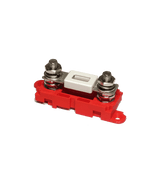
- Function
- Fuse holder for STS strip fuse
- Current rating
- max. fuse rating 250 A
-
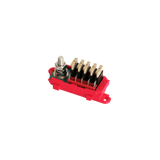
- Function
- Fuse block for 5 automotive fuses (circuit breaker series 1610)
- Current rating
- Total current rating 30 A, max. fuse 20 A
-
- Function
- Negative busbar, 3-way, 150 mm²
- Current rating
- Current rating 250 A
-
- Function
- Negative busbar, 6-way, 150 mm²
- Current rating
- Current rating 250 A
-
- Function
- Connecting link, nickel-plated copper, hole spacing 25–33 mm
- Current rating
- Cross-section 80 mm²
-
- Function
- Connecting link, hole spacing 53 mm or 53+40 mm
- Current rating
- Cross-section 80 mm²
-
- Function
- Connecting link, hole spacing 80 mm
- Current rating
- Cross-section 80 mm²


Frequently asked questions. Briefly answered.
What exactly is the Power Install System (PIS)?
The Power Install System (PIS) is philippi's modular main distribution system for high-current components. Instead of connecting main switches, fuses and busbars individually with flexible cables, the components are joined mechanically and bolted together using matching copper links. The result is a compact, robust main distribution without loose wiring.
Which vehicles and applications is the PIS suitable for?
The system is designed for boats, motorhomes, campervans and commercial vehicles. It suits any installation in which the starter battery and the house battery must be fused separately and distributed to several outputs. A typical use is as the central main power distribution close to the batteries, from which all large loads and sub-distributions are supplied.
What advantages does the PIS offer over conventional cable wiring?
You save space, installation time and costs because main switches, fuses and busbars no longer have to be wired individually. Since all connections are made firmly via copper links instead of individual cables and cable lugs, there are fewer contact points. This reduces the risk of errors during installation and increases the safety of the main distribution in operation.
Which components make up the system?
The PIS includes mechanical or remote-controlled main switches (FBA, TSA, FBC), fuse blocks and fuse bars (for example EBF and ESF), busbars (EMS) and connecting bars (EBV, SDV-N). All parts are precisely matched and bolted directly together, so the main distribution can be assembled from the modules your onboard system needs.
How complex is the installation – do I need a specialist?
Thanks to the plug-in principle, installation is much faster than with conventional wiring, because the copper links define the connections. For the initial installation we nevertheless recommend a specialist workshop. Workshops in particular benefit from the reduced installation time and the clear system architecture, and the main distribution is correctly fused and documented from the start.
Where can I get advice on the right configuration?
We are happy to help you choose the right components for your project. Simply contact our team and tell us the system voltage, the battery banks and the planned loads. On this basis we put together a suitable configuration of main switches, fuses and busbars for your boat or vehicle.
The components. Modular and expandable.

Fuse bar EBF 3 for 2 MRBF bolt-down fuses
33,90 €
Fuse bar EBF 4 for 3 MRBF bolt-down fuses
45,50 €
Fuse bar EBF 5 for 4 MRBF bolt-down fuses
56,50 €
Fuse bar EBF 6 for 5 MRBF bolt-down fuses
67,90 €
Fuse block ESF 5 for 5 blade fuses
39,90 €
Negative busbar EMS 3, Power Install System
34,90 €
Negative busbar EMS 4, Power Install System
68,90 €
Negative busbar EMS 5, Power Install System
68,90 €
Negative busbar EMS 6, Power Install System
68,90 €
Connecting bridge SDV-N for ANL fuse holders
from 10,90 €
Battery master switch EBH 250
109,00 €
ANL fuse holder ESH for STS strip fuse, 250 A
22,90 €
Remote-controlled battery main switch FHR 265
189,00 €
Remote-controlled P-bus circuit breaker FHC 265
229,00 €